Lark Ascending, Farewell to Stromness, Czech Suite and more… Saturday 29 October, St. Mary’s Church, Thame, 7:30pm
It’s a delight to collaborate again with Crendon Chamber Orchestra. I’m looking forward to exploring Vaughan Williams’ amazing evocation of lark-flight with violinist, Madeleine Pickering.
We will pair the Vaughan Williams with another outdoors gem: Maxwell Davies’ Farewell to Stromness, arranged for strings by Rosemary Furniss.
Two large-scale works for chamber orchestra complete the programme: Dvořák’s Czech Suite is a masterclass in Czech dance rhythms, richly characterised by superb orchestration; and the concert opens with Malcolm Archer’s Variations for Orchestra on a Theme of Ruth Gipps.
I’m over the moon to be collaborating with a wonderful professional orchestra on a project featuring my compositions. More on that very soon.
In other news, the Harry Woolhouse Charitable Trust are commissioning a work by me for Imperial College Sinfonietta, to be performed next summer. More on that soon, too; but think bogs… think peat… think space. Bogs are our glaciers in UK and Ireland. They move, they breath, they shield.
Also, I’m delighted that Sands Films Studios want to feature The Singing Glacier in a festival in March 2023.
Finally, listen to this: Cliffs, by Garefowl, inspired by St Kilda. St Kilda has the highest cliff in the UK, Connachair, which falls 1401 ft to the sea. These sounds call me towards a sail voyage in 2025 to the great cliff of Cape Enniberg in the Faroe Islands – a staggering 2474 ft drop. Thank you, Anna Lowenstein, for the recommendation.
What a joy this was. So good to be making music abroad again! Fantastic to be part of the combined energies of Imperial College Symphony Orchestra and Imperial College Sinfonietta.
It was a great pleasure to share the podium with Oliver Gooch; and the Imperial students were true ambassadors for Imperial College. At every turn we were bowled over by the hospitality and attentiveness of our Czech colleagues, as well as the audiences in St. Simon & Jude, Prague; St Ann’s, Karlovy Vary; and Jindřichův Hradec Castle. Huge thanks to the student committees, and to the tour consultants, ACFEA.
7.30pm, St Saviour’s Church, Sandpit Lane, St Albans AL1 4DF
Two days short of Independence Day, SASO will celebrate with two American classics: Dvorak, Symphony No. 9, ‘New World’ and Barber, Violin Concerto, with soloist David Le Page. The concert also features the ballet music from Holst’s opera, The Perfect Fool.
This concert is dedicated to the memory of Tom Hammond, SASO’s Principal Conductor, who died in December 2021. One of Tom’s passions was the music of Sibelius. We will celebrate Tom by performing Sibelius, The Swan of Tuonela.
A new work for Imperial College Sinfonietta, to feature current members and alumni.
I am delighted to have been commissioned by the Harry Woolhouse Charitable Trust to write a new work to mark the quarter-centenary of Imperial College Sinfonietta. To be performed in 2023/24. The piece will reflect the adventurous spirit of Harry Woolhouse and Sinfonietta. It’s a fantastic opportunity to celebrate the Sinfonietta community and, in particular, the amazing work that current members and alumni do in the field of climate adaption. More details soon.
Imperial College Sinfonietta was joined by alumni from the past 25 years for a festival weekend, culminating in a concert given by a massed orchestra of over 100 players. We were delighted to welcome back the founding conductor, Daniel Capps, to conduct Prokofiev, Symphony No. 5. We were also thrilled to perform Schumann, Cello Concerto,with alumnus, Elizabeth Porter. Our Honorary President, Sir Robert Lechler, gave a welcome speech.
The weekend was an opportunity for the wider Sinfonietta family to meet and reminisce, and a wonderful time was had by all. It was also a golden opportunity for us to highlight the work of the Harry Woolhouse Charitable Trust, named after alumnus, Harry Woolhouse. The trust supports the current membership, and the long-term future of the orchestra.
FSO gave a beautiful performance of Mahler’s Symphony No. 1 in Princes Hall to mark the end of our 100th Anniversary Season. We opened the concert with Joby Talbot’s Chacony in G minor, composed for the BBC Proms in 2011. Mozart’s Symphony No. 35, ‘Haffner’, completed a glittering musical offering that brought nearly 80 musicians together before an appreciative audience.
Recorded at the premiere on 22 January by Farnborough Symphony Orchestra. Listen here.
FSO is grateful to the sound engineer and producer, Haresh Patel, for recording the premiere live.
FSO performed Mountain Hare in a Scottish themed concert that included Mendelssohn’s Hebrides Overture and Scottish Symphony.
Mountain Hare was inspired by my research into Mountain Hares in the Cairngorm mountains, Scotland, and was supported by a Finzi Trust Scholarship. There is also a version for violin, cello, piano and clarinet. Bill wrote a travel essay about the research process called Composing in the Cairngorms. You can read extracts from that, and about an intriguing disco ball metaphor for the hare here.
A beautiful programme in the fabulous acoustic of the cathedral. We are joined by soprano, Jessica Cale, organist, Andrew Parnell, and Gloriana choir, under their director, Deborah Miles-Johnson. Tickets.
Poulenc: Ave verum corpus Debussy: Nocturnes Canteloube: Chants d’Auvergne Faurè: Cantique de Jean Racine Saint-Saëns: Symphony No.3, Organ Symphony
The students of Imperial College Sinfonietta celebrate their upcoming holidays with two glittering orchestral showpieces and Sibelius’s soaring second symphony. Advance tickets here (select ‘non-student tickets’ in the drop-down menu) for £8 or £9 on the door. Map here.
7.30pm, St Saviour’s Church, Sandpit Lane, St Albans AL1 4DF
Arnold, Clarinet Concerto No.2 with Mark van de Wiel; Arnold, Symphony No. 5; Brahms, Symphony No. 3.
St Albans Symphony Orchestra (SASO) celebrates Malcolm Arnold’s centenary year with these two stunning works, in a programme designed by SASO’s much-missed principal conductor, Tom Hammond. It’s a great pleasure for us all to work with Mark van der Wiel, Principal Clarinet of the Philharmonia, in Arnold’s super jazzy concerto, written for Benny Goodman. Brahms’ third symphony rounds off an evening of uplifting and moving music-making. I’m honoured to be conducting SASO this season. Information and tickets here.
I have Covid so I’m very grateful to Orlando Jopling for stepping in to direct CCO this Saturday 26 Feb at St. Mary’s Church, Thame, 7:30pm
Arnold, Concerto No.1 for Flute and String Orchestra with Sirius Chau; Dag Wiren, Serenade for Strings; Sibelius, Suite Champetre; Janacek, Idyll for String Orchestra.
Beginning with a chance to hear the highly-acclaimed young flautist, Sirius Chau, the programme ends with a delicate Sibelius suite and an early work of Janacek that includes one of the most beautiful tunes in 5-time ever written.
The collaboration between Orlando and CCO will be stunning. Enjoy it with the loyal CCO audience in the beautiful accoustic of St Mary’s, Thame. Tickets and details. All the best to everyone for a fantastic concert. I look forward to reuniting with CCO soon!
Farnborough Symphony Orchestra is brilliant for performing contemporary music. Recent concerts have included works by Charlotte Bray, David Matthews and Elizabeth Winters. We are also proud to run the Farnborough Young Composers Competition.
I’m thrilled that FSO performed Mountain Hare in this Scottish themed concert which also included Mendelssohn’s Hebrides overture and his Scottish Symphony.
Mountain Hare was inspired by my research into mountain hares in the Cairngorm mountains, Scotland, and was supported by a Finzi Trust Scholarship. There is also a version for violin, cello, piano and clarinet. I also wrote a travel essay about the project called Composing with Hares. You can read extracts from that and about an intriguing disco ball metaphor for the hare here.
‘Ten years ago everybody thought it was crazy to transport goods in sailing ships. Now it is a rising trend for companies to watch their entire production chain for sustainability. Soon customers will demand clean transport…’ (EcoClipper website.)
If you are interested in joining the second round of investment contact Captain Jorne Langelaan and the EcoClipper office via the investment form. If you are interested in taking part in the sailing revolution here is a great article by Jess Clay of EcoClipper that includes a section on sail cargo.
Communications and website design for the Eco Sail sector. Farewell C&H. Welcome Guild of Ships!
I set up Clarity & Hart (C&H) in 2020 as part of the ecological concern of my total work. Our amazing team advised on communications, produced content and created websites for the Eco Sail sector. For example, we created Grayhound Shipping from scratch. We collaborated with eco sail companies in Scandinavia, the Netherlands, the UK and Central America. I was also honoured to work with the designer and performer extraordinaire, Taragh Bissett.
Through C&H, I made many friends in the Eco Sail community. I am now Co-founder and COO of Guild of Ships (GOS). GOS is a bookings and circular economy platform for the Eco Sail sector. We facilitate passenger and cargo bookings via the GOS booking platform, and we charge commission.
GOS is a true ‘guild’. Members join the guild for free (whether or not they use the booking system). They may also choose to recommend other GOS members and win a small commission. At the end of each year, the guild membership votes on how to allocate the GOS profits. For example, we may help a guild member in need; or we may set up the next ‘Guild of — ‘ for another environmentally responsible sector.
GOS is proud to be a member of Fair Winds Collective — an incredible community of companies who are changing the world one ship (and shipment) at a time. Read more about GOS and these other companies in the FWC magazine, ‘Set Sail with Purpose‘.
This is such a blast. The playing by Ellie Fagg, Tom Norris, Dorothea Vogel and Orlando Jopling is world-class and there is advice on food and wine to go with the music! The Raz Club is for people who enjoy great music, food, wine and the company of others. It’s a way of coming together with like-minded people to enable musicians to keep on making music and sharing it with others. I’m honoured to be there with the wine writer Nina Caplan.
Bill introduces a live-streamed lunchtime concert featuring Daniel King-Smith, piano
27 November, available online
Bill gives the introductory talk for this live-streamed recital given by undergraduates at Imperial College, London. He shares the background to the pieces, including a little about Liszt’s relationship with the writer, Comtesse Marie d’Goult, pen-name Daniel Stern.
As part of the BBC’s annual Contains Strong Language spoken word festival, Elizabeth Alker talked to writer Helen Mort about her musical collaborations, including The Singing Glacier. Composer Sophie Cooper revealed a new piece written in response to one of Helen’s poems. The programme included a clip from The Singing Glacier in the version for modern violin and piano, featuring Flora Curzon, violin.
Heath Street Baptist Church ‘Home Companion’ radio show and newsletter
During the first lockdown these radio programmes included thoughtfully-curated poetry, readings and songs, featuring members of the congregation. As well as contributing to these, Bill was happy to feature in the September – November newsletter.
Part of the touring production, ‘Strange Creatures’
Bill was commissioned by MishMash Productions to write a trio using just vocal sounds and body percussion for this fantastic show. You can see the piece, called ‘Grumpy Trio’ performed here by Charlotte Fairbairn, Flora Curzon and Sophie Rivlin, starting at 3’30”.
Knoydart is the uppermost of the peninsulas that make up the Rough Bounds in Northwest Scotland, an area intruded by deep sea lochs (including Scotland’s deepest, Loch Morar) and characterised by mountainous horizons. They overlay each other like lines of music, and the striations in the rock provide other melodies. Work in progress.
Introducing lunchtime concert series at Imperial College, London
5 November 2020, 12.45pm
Concert available on YouTube. Bill gives an introductory talk (starting at 00:48) about the collaboration between Beethoven and violinist Franz Joseph Clement that produced this radiant and intimate concerto. I Musicanti perform it in an arrangement by Carl Hinde for string quintet, with soloist Tamás András.
Science and Art: Climate Change and The Singing Glacier
Manchester Metropolitan University
June 2020
Part of the Science and Art series. Poet Helen Mort and Physical Geographer Kathryn Adamson share their experiences of East Greenland and discuss how science and art can interlock to communicate the effects of climate change. Featuring an extended extract from The Singing Glacier.
‘Lamb’ is a new film by Nashashibi/Skaer with a soundtrack created by Bill, mezzo soprano Olivia Ray and Rosalind Nashashibi. The footage from a lambing shed was shot by Lucy Skaer on Lewis and Harris in the Outer Hebrides.
Listen here to the premiere given by Farnborough Symphony Orchestra in 2022, recorded by Haresh Patel. Perusal score €20. Hire score & parts by negotiation. 2222; 4200; timp; strings. Three movements, total 20 mins. Movements 1& 2 can be performed separately or as a pair.
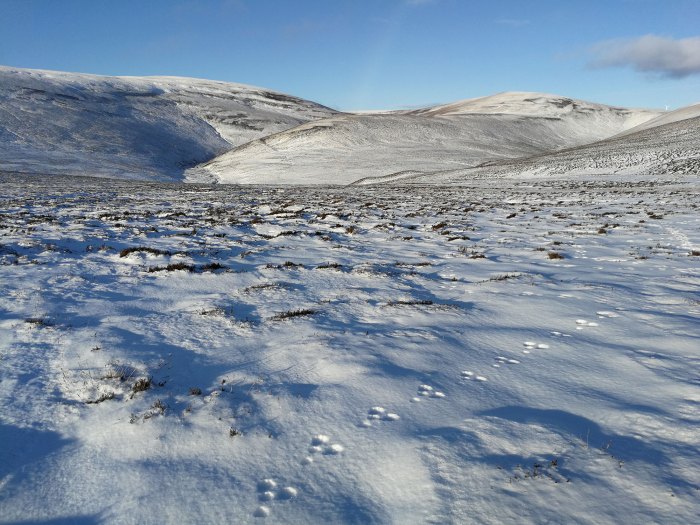
A Finzi Scholarship project. Inspired by two solo camping trips in 2018 looking for Mountain Hares in the Cairngorm mountain range, Scotland. Bill also wrote a travel essay, Composing with Hares (see extract below).
Over the course of his two trips, Bill connected with these elusive animals. He also saw golden eagle and red deer. Mountain Hare is inspired by the land, the movements of the hares themselves and his experiences in this large subarctic area. Movement II, in particular, reacts to the power of the wind.
Note about hares. The Mountain Hare, Lepus timidus, is a survivor from the last ice age. It is related to Arctic and Greenland hares. There are isolated Mountain Hare communities in the Alps, Ireland and Scotland – each genetically distinct. The Brown Hare, Lepus europaeus, arrived in Ireland and the UK thousands of years later.
Extract from Composing with Hares:
It was a hare encounter in Ireland that tipped me into composing something. Mount Shehy, Cork, on a blue-skied day in July. From the top, the sparkling western coastline with its endless diamond inlets stretching south and north from Bantry Bay. Inland, the tightly packed fields competed with hedges for green luminosity. As I descended the lip of the ridge into the heathery seclusion of the mountain range, I disturbed two large, russet-gold forms. They rose up, side-by-side, as if glued. Remaining like this, they pushed at speed through the vegetation — I could hear their flanks flushing the heather and grass. They stayed in tandem, as if sewn together; then turned, in formation, doubled back, and soared up the hill, splitting just before the skyline: two vanishers in a rim of light.
The Shehy range takes its name from the Irish, Cnoic na Seithe, meaning ‘Hills of the Animal Hides’. Perhaps the mountains are used to ‘Indicating, by no Muscle – / The Experience’ (Emily Dickinson, Bloom on the Mountain—Stated) but this was new to me. These were clearly foxes… no, huge hares… no, foxes. I had to challenge my eyes with the long ears and short tails. Only as they disappeared into the sky did I realise I had seen the fabled Golden Hare. If I had been a hunter, their strategy would have confused me and saved at least one life. As it was, the duet played with my mind.
Commissioned by the Harry Woolhouse Charitable Trust to celebrate the 25th anniversary of Imperial College Sinfonietta. Inspired by one of Europe’s major raised bogs, Carrownagappul, Co. Galway.
For baroque ensemble. Collaborative response to glaciers, commissioned by The Little Baroque Company. In 2016 Bill and the poet Helen Mort climbed in East Greenland.
Violin, Flora Curzon; voice, Helen Mort; piano, Bill Carslake
A collaborative response to glaciers in East Greenland.
Commissioned by The Little Baroque Company to celebrate its 10th anniversary. Perusal scores for the two baroque ensemble versions: €20 each. Hire parts for each by arrangement, please enquire.
In 2016 Bill went to Kulusuk, East Greenland with the poet Helen Mort for an exploratory climbing expedition. They were joined later by the film-maker Richard Jones.
The piece combines instrumental music by Bill, new poetry written and spoken by Helen and film taken by Richard and others in the team.
Modern violin with piano, as featured in this recording
This recording features Flora Curzon on modern violin and Bill on piano. It reprises their performance with Helen at the Daniel Corkery Summer School in 2017.
In 2019 Hercules Editions published Helen’s poems as The Singing Glacier, including a conversation between Helen and Bill, some of the musical score, paintings by Emma Stibbon RA, and an essay by the literary geographer, David Cooper.
The Singing Glacier also exists as a schools education project including: word and poetry challenges devised by Helen, two Greenlandic bone games purchased in Kulusuk, musical composition games devised by Bill, and the short film below, created by Richard to inspire children (and adults!) featuring Matt and Helen Spenceley, our amazing guides from Pirhuk – Greenland Mountain Guides.
Short film about the context of The Singing Glacier, featuring Helen and Matt Spenceley of Pirhuk – Greenland Mountain Guides.
Finzi Scholarship piece inspired by Mountain Hares in the Cairngorms. Classical orchestra version (2,2,2,2; 4,2,0,0; timp; strings) and potential chamber version (violin, cello, piano, clarinet). Bill also wrote a travel…
Violin, Helen Kruger; viola, Virginia Slater; keyed glockenspiel, Bill Carslake
Written to raise the profile of the Kickstarter crowdfunding campaign for The Singing Glacier. For violin, viola and glockenspiel (keyed or normal). There is an additional performance option for this piece: after the second time through, it can be repeated ad libitum and, each time, more notes are omitted, at the players’ discretion. PDF perusal score €10; hire parts €20 per set per performance, plus postage, with rates negotiable if being repeated on tour.
Commissioned by the Harry Woolhouse Charitable Trust to celebrate the 25th anniversary of Imperial College Sinfonietta. Inspired by one of Europe’s major raised bogs, Carrownagappul, Co. Galway.
Finzi Scholarship piece inspired by Mountain Hares in the Cairngorms. Classical orchestra version (2,2,2,2; 4,2,0,0; timp; strings) and potential chamber version (violin, cello, piano, clarinet). Bill also wrote a travel…
Extracts from Circus. Piano, Sarah Latto; soprano solo, Catherine Shaw
In 2014 Bill walked up Mount Kilimanjaro, Tanzania. Sitting beside his tent at basecamp, he watched white-necked ravens duetting, mid-air. This included flying in mirror formation – one upside down beneath the other – parting, then soaring directly towards each other and clasping talons. This aerial display in the oxygen-poor air at c. 5800m left a lasting impression and inspired the poem Circuswhich he set for SATB choir, solo soprano and solo piano for a commission from King’s School, Worcester. The piece is currently being revised.
Finzi Scholarship piece inspired by Mountain Hares in the Cairngorms. Classical orchestra version (2,2,2,2; 4,2,0,0; timp; strings) and potential chamber version (violin, cello, piano, clarinet). Bill also wrote a travel…
For baroque ensemble. Collaborative response to glaciers, commissioned by The Little Baroque Company. In 2016 Bill and the poet Helen Mort climbed in East Greenland.
Commissioned by the Harry Woolhouse Charitable Trust to celebrate the 25th anniversary of Imperial College Sinfonietta. Inspired by one of Europe’s major raised bogs, Carrownagappul, Co. Galway.
The Particles series is about the viscosity of air, which sparkles around us, pushing against everything we see. Particles 1, 2 & 3 exist in two versions: for solo violin with different orchestral sections (Particle 1 – double basses; Particle 2 – violas; Particle 3 – second violins); and also for cl, vln, vc, pno, as arranged for Alisios Camerata, Zagreb. The Alisios Camerata performance of Particle 2 at Banff Centre can be watched here. There is an additional arrangement of Particle 2 for youth orchestra, written for London Music Masters, in which professional tutors play the demanding passages.
The cl/vln/vc/pno performance set is available for hire at €30 per performance (lower rates available for tours). Performance sets for the original setting (solo violin + orchestra) can be hired by agreement.
A suite of five movements for clarinet, violin, guitar, double bass, harpsichord and timpani. Written as sound-tracks for short films produced by Sands Films. Now available as a concert suite.
A suite of five movements for cl, vln, gtr, db, hpscd*, timp*. Commissioned by Sands Films Studios as soundtracks for short films. Now available as a concert suite. *The harpsichord part can be played on piano (preferably upright) and the timpani part on a smaller drum if necessary. Perusal set of PDFs €20. Score/parts sets for hire at €10 per movement per performance (negotiable rates for repeated performances on tour).
London Life mvnt 4. Clarinet, Ewan Bleach; violin, Max Bailey; double bass, Dave O’Brien; production (including sampled guitar, harpsichord and timpani) Anthony Weeden.
Cl, vln, vc, pno. Also in version for solo vln and orchestral sections (dbs, vlas, second vlns). Inspired by the viscosity of air. It sparkles and dances around us, pushes…
Short film by Nashashibi/Skaer with sound-track by Bill, mezzo-soprano Olivia Ray and Rosalind Nashashibi. Footage of a lambing shed from the Island of Lewis and Harris shot by Lucy Skaer.
Lamb featured in the Nashashibi/Skaer exhibition, Future Sun at S.M.A.K Gallery, Ghent, Belgium, November 2019 to February 2020. It can be hired from Lux.
Commissioned by Mishmash Productions for their touring show, Strange Creatures. ‘Grumpy Trio’ is performed using just vocal sounds and body percussion.
In 2018/19 I took two solo camping trips in the Cairngorms and one in the Peak District to research mountain hares for a composition, supported by the Finzi Trust. The composition is called Mountain Hare, for orchestra. The orchestral premiere was on 22 January 2022.
I wrote an extended travel essay called Composing with Hares about the process of camping and composing in the largest subarctic landscape in the UK. You can read extracts from this below. While in the Cairngorms, I met with Anna Fleming (Time on Rock, Canongate 2022) and our conversation features in her essay, Dances with Hares, in the anthology, Women on Nature, edited by Katharine Norbury.
As we sup tea in the cold wind, Bill asks, “How would you represent a mountain hare on the stage?” I pause, turning the unusual question over like a pebble in my mind and a surprising metaphor leaps out. A disco ball. Hares catch the eye in a dazzle of (almost ridiculous) movement. The hare’s myriad nature – running, hiding, watching, relaxing, frisking, quaking, yawning, bathing – are flashes of a thousand glittering faces. And beneath this reflective exterior, something is hidden. There is always an aspect of the hare that remains unseen, unknown. They are creatures of the mountain.
(Extract, Anna Fleming, Dances with Hares, from Women on Nature, edited by Katharine Norbury, Unbound 2021)
In a 13th century poem about hares, translated in the 20th century by Seamus Heaney as The Names of the Hare, seventy-seven names are given for the brown hare, Lepus europeaus. Whether it is in awe or jest is unclear, but it gives an idea of the hare’s status in western folklore. Amazingly the heart weight in relation to body weight in both brown and mountain hares is bigger than in most animals, including humans, dogs, cheetahs, lions and whales. This large heart allows them to start fast and stay fast for a long time. At 40 miles per hour their front legs don’t even touch the ground! This heart could also be the source of their fabled intelligence and wisdom. In the beautiful Buddhist tale of the Selfless Hare the Bodhisattva is reborn as a hare. Sakra, Lord of the Heavens, comes to earth to test the virtue of the hare and its three friends – the otter, jackal and monkey. Sakra meets each separately. “I am hungry.” The otter, jackal and monkey each give the food they were looking forward to eating. The hare has only grass, so it asks Sakra to create a fire, then leaps into it to offer his body as a meal. The astonished Sakra puts the fire out and rewards the hare by painting it on the moon, so that its bravery shines everywhere.
1) When it stops, it is your nonchalant drummer beating with its paws on the ground – we still don’t fully understand why. Feel and hear the footpad tap on a slightly caking peat surface… Now imagine having the hearing of those great, swivelling ears. Consider that the hill is endless drums. Peat skin taut above sloshy, resonant mass; or thin peat clinging to echoing rock. How deep does the mountain hare hear and tell? Take the dome of St Paul’s. Upend it, submerge it, and whisper in the gallery with your feet. Now smell in colour, and see in detail a mountain and heather-filled orb of a couple of kilometres. With your big amber eyes on your elegant head you can almost see the full round. What a session!
2) In winter the plateau can be one of the most exposed and seething skins in the mountain body of the UK. You walk, but the wind will throw you to the ground. Sometimes you will crawl. Imagine for a moment that you are sitting with a mountain hare on the aperture edge of a Bunsen burner on maximum power. In your terror, as you try to maintain your hold, you can feel the assault on your always-open ears. Your nose’s inability to close doesn’t help. In winds as powerful and constant as this it is a wonder that the mountain hare sits calmly beside you, flattening into the iron. In its ‘form’ on the Cairngorm plateau – by the subtlest body alignment – it experiences such quietness that it becomes the eye of the storm. Some years ago, in a strong wind on a mountain in Glen Cannich I laid my head in a hare form and was astonished to find pin-drop silence.
3) For a virtuoso of concealment like the hare, the open ‘tundra’ landscape of the plateau is home and hiding. I could see plenty of pellets. Away from the tourist trail and un-trampled by humans, these remote tops provide less food, but for the variety of vegetation they are hard to match. There are miniature willow and birch trees which, at a height of one inch, hold out tiny red and gold autumn leaves to catch the light and breeze. Yellow grasses whistle above squat banks of red sorghum moss, glowing like coral. Scattered rocks sport bleached lichen, and glint with embedded flecks of quartz. It’s a bedazzling beauty when the sun’s at play. A heavenly field. What a place for a first sight! But after walking two miles further eastwards I was still – to my eyes at least – alone on the hill.
4) [Referring to the memorial service in Notre Dame after the Paris bombings.] Paris was numb. Gradually [the organist] Latry released low, husky, indeterminate waves into the gloom. He graded these until recognisable pitch and volume held sway. Music and urgency increased and entered the hearts of over 6,000 of us, seated below. The playing grew in speed and richness; the sound took on a dangerous edge. The colours darkened and the volume increased, until it became the angriest, most violent music I have ever heard. I was furious, and I wasn’t alone. Just when I wished the anger and pain would end, imperceptibly the sounds softened, curved, became solemn and warm. A beautiful melody emerged from the texture, becoming less clothed, less weighed-down and simpler as it soared. Now it was song-like and – after a brief, missed heartbeat – it was joined by the choir who, we realised, were processing down the side aisle. We had been guided and allowed to grieve.
Yes, I know, God’s silence never breaks, but is that really a problem? There are thousands of voices, after all.
Parallel Worlds – notes on the historical context and music of The Firebird by Igor Stravinsky
Article
As part of the ‘lockdown’ provision for the Farnborough Symphony Orchestra community, Bill wrote an in-depth exploration of the piece that would have been performed in their March concert, cancelled due to COVID-19. In Parallel Worlds he explores the motivation and meaning behind the piece that made Stravinsky an international star overnight: his ballet score for the Ballets Russes’ The Firebird, performed in April 1910.
Musical Director of Farnborough Symphony Orchestra since 2018. Recent programmes have featured works by Charlotte Bray and David Matthews. The inaugural Farnborough Symphony Orchestra Young Composers Competition in 2019 was won by Sam Gooderham with his piece, Candlewright
Musical Director of Sinfonietta since 2013. The orchestra champions innovative programming and staging dispositions and tours annually. A very welcoming orchestra, it is open to players from outside Imperial College, so contact if you are interested.
Bill has a long and fruitful relationship with Wolsey Orchestra, performing with world-class soloists in the grand old Corn Exchange in Ipswich, and the stunning acoustic of The Apex in Bury St Edmunds.
Bill has run this wonderful baroque music course with Theresa Caudle since 2010. Open to all amateur baroque enthusiasts – with bursaries available for young professionals – it is a chance to work intensively on a different repertoire area each year. The next course is 21-24 September 2020.
Co-leading the annual ‘Song Story’ and ‘Summer School’, composing and arranging music inspired by a different composer each year, working with Special Educational Needs schools across Somerset (Song Story) and chidren in the Frome area (Summer School).
In this unique professional partnership Bill and Patrick create immersive musical performances with students in Special Educational Needs schools across the UK. Their work has been the subject of a BBC Radio 4 documentary, When Words Fail, Music Speaks.
A response to ‘lockdown’ in the UK during the COVID-19 emergency
Poetry
For nine consecutive days from 24 March 2020 Bill wrote a new poem or ‘lyric’. Each has three lines of nine syllables, creating ‘999’ for the state of emergency. These lyrics are set to music for two voices and cello. He also wrote a three-part Rainbow Round and a three-part Bell Canon.